


Ovarian cyst diagnosis
Ultrasound and making sense of test results
- Seeing the word “cyst” on an ultrasound report does not mean cancer.
- Ultrasound is the main way to examine a cyst, and how the cyst looks matters as well as its size.
- Neither a blood test nor the size of a cyst can show on its own whether the cyst is benign (not cancer) or cancerous.
- Your age, symptoms and menopausal status, and any changes in the cyst during follow-up, guide the next decision.
- A complex or growing cyst, or a cyst found after menopause, needs a more detailed assessment.
Video in Persian
From anywhere in the world
Tehran clinic services
Seeing the word “cyst” on an ultrasound report can be worrying, but most ovarian cysts are benign. Your doctor looks at the cyst’s size and appearance, your symptoms and your situation to decide whether follow-up or further tests are needed.
An ovarian cyst is not the same as ovarian cancer
In women who have not reached menopause, the chance that an ovarian cyst is cancerous is very low (about 1 in 1,000 for cysts that cause symptoms), and this chance is higher after menopause.
The chance goes up with age, especially after menopause; even so, each person’s risk also depends on how the cyst looks and on other findings.
The aim of these tests is to separate low-risk cysts from those that need a closer look.
Which findings need a closer look?
- A cyst found after menopause
- A complex appearance on ultrasound, such as an irregular wall, a dividing wall inside the cyst (septum) or a solid area
- A cyst that grows or changes in appearance on follow-up ultrasounds
These findings are not proof of cancer; they only show that further assessment is needed.
If you have questions about cancer, how it is diagnosed or the outlook, you can find fuller information on the ovarian cancer page.
How do you know if you have an ovarian cyst?
Many cysts cause no symptoms and are found during an ultrasound done for another reason. Symptoms alone cannot prove that a cyst is there.
Possible symptoms of an ovarian cyst
- A dull ache or a feeling of heaviness in the pelvis, sometimes more on one side
- Bloating or a feeling of fullness in the abdomen
- Changes in your periods, or pain during sex
- Needing to urinate more often, or a feeling of pressure on the bladder
Having no symptoms does not rule out a cyst
Many cysts are found by chance. On the other hand, these symptoms can also have other causes; an ultrasound and your doctor’s opinion make the next steps clear.
Ultrasound: the main way to diagnose an ovarian cyst
An ultrasound shows where the cyst is, its size and appearance, and whether it contains fluid or solid parts. The type of ultrasound is chosen according to your situation and with your consent.
Transvaginal ultrasound
It usually gives a closer, more detailed view of the ovaries. It should be done with a clear explanation, with your consent and with your personal circumstances in mind.
Abdominal ultrasound
This is done over the abdomen, usually with a full bladder. It is a suitable option for some people and for larger cysts.
Other options
If a transvaginal ultrasound is not suitable or acceptable for you, an abdominal ultrasound is one of the main alternatives. If the images are not clear enough to assess the cyst, your doctor may suggest further imaging such as an MRI.
Best timing for the first ultrasound and follow-up scans
For the first ultrasound, you usually don’t need to wait for a particular day of your cycle. If the cyst may be a temporary functional cyst and your doctor thinks follow-up is needed, a repeat ultrasound may be requested about 8 to 12 weeks later (2 to 3 months later), preferably in the first days of your menstrual cycle (the first days after your period starts).
Not every cyst needs a repeat ultrasound. The timing of follow-up depends on the cyst’s size and appearance, your symptoms and your menopausal status.
What common terms in an ovarian cyst ultrasound report mean
Each term describes one aspect of how the cyst looks; no single word or number is a final diagnosis on its own.
Follicle, simple cyst and functional cyst
A follicle is a normal part of the ovulation cycle: it is where an egg grows. A simple cyst is usually a fluid-filled sac with a thin, smooth wall. A functional cyst forms as part of the ovulation cycle. “Simple” describes how the cyst looks, while “functional” refers to how it formed.
A normal follicle is not a disease. Many functional cysts go away on their own. Whether a cyst needs follow-up depends on its size and appearance, your symptoms and your menopausal status.
Hemorrhagic cyst
A cyst with bleeding inside it.
It is often benign and may go away as the body absorbs it, but it sometimes causes pain and needs follow-up.
Dermoid cyst (mature cystic teratoma)
A growth, usually benign, that can contain tissues such as fat or hair.
Whether it is monitored or removed with surgery depends on its size, appearance and symptoms.
Endometrioma or “chocolate cyst”
A cyst linked to endometriosis that contains old blood.
It needs assessment and follow-up tailored to endometriosis.
Complex, septum, nodule or solid component
“Complex” means the cyst does not look simple: for example, it may contain blood, a septum or a solid part. A septum is a thin dividing wall inside the cyst. A nodule is a small bump on the cyst wall or on a septum, and a solid component is a part of the cyst made of tissue.
It needs a closer look, but on its own it does not mean cancer.
Size, for example 23 mm
Size is usually written in millimeters; for example, 23 mm equals 2.3 cm.
Size matters, but it is interpreted together with the cyst’s shape, your symptoms, your age and your menopausal status.
Your ultrasound report is a guide rather than the final word
Your doctor reviews the ultrasound result together with your age, menopausal status, symptoms and any changes in the cyst over time. Don’t let one phrase alarm you, and don’t set the result aside without follow-up.
What can an ultrasound and a CA-125 test show?
A CA-125 test on its own cannot prove that a cyst or cancer is present; how useful it is depends on the ultrasound result, your age and your overall medical situation.
Ultrasound

It shows where the cyst is, its size, shape and contents (fluid, solid or mixed).

On its own, it cannot confirm for certain whether a cyst is benign or cancerous.
CA-125 blood test
In some cases, together with the ultrasound and your situation, it helps estimate the chance that a mass is cancerous. This test is not needed for every cyst. In women under 40 with a mass that does not look simple, the doctor may also order hCG, AFP and LDH blood tests.
A high level does not confirm cancer on its own, and a normal level does not rule cancer out for certain. Benign conditions (such as endometriosis, fibroids and pelvic inflammatory disease, a pelvic infection) and even periods and pregnancy can also raise it.
Tissue examination (pathology) after surgery
If you have surgery, the removed tissue is sent to the lab to be examined under a microscope, so the exact type and nature of the mass can be determined.

No, it is not needed for every cyst. Surgery may be suggested because of symptoms, the cyst’s size, growth or persistence, or concerning findings. If a cyst is removed, its tissue is sent for pathology even if it looks benign.
A high CA-125 does not necessarily mean cancer
- Before menopause, benign conditions and even the menstrual cycle can raise this number, so the result should always be interpreted together with the ultrasound and a physical exam.
- Your doctor assesses the chance of cancer by looking at the cyst’s appearance, your age, menopausal status and symptoms, and your test results, all together.
- After menopause, too, the need for follow-up and further tests depends on the cyst’s features, your symptoms and the test result. If there are concerning findings, a more specialized assessment is needed.
How is an ovarian cyst different from PCOS, endometriosis and fibroids?
These conditions are not the same, and each has its own path for diagnosis and follow-up.
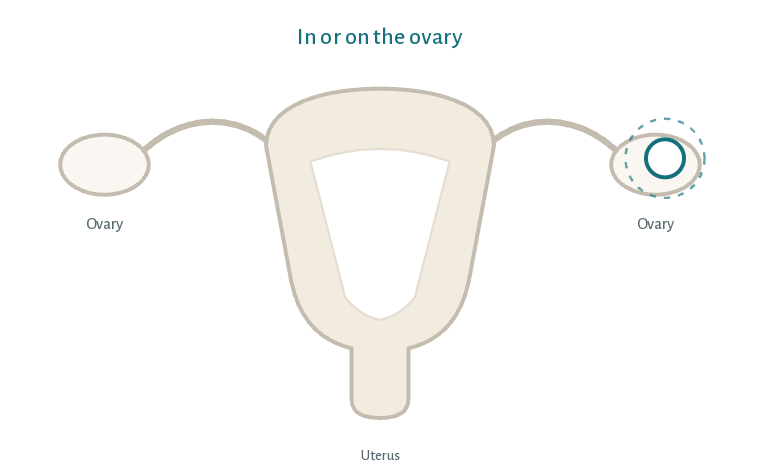
Ovarian cysts
A sac, often filled with fluid, in or on the ovary. Most cysts are benign. Many functional cysts, which are linked to the ovulation cycle, go away on their own within a few months.
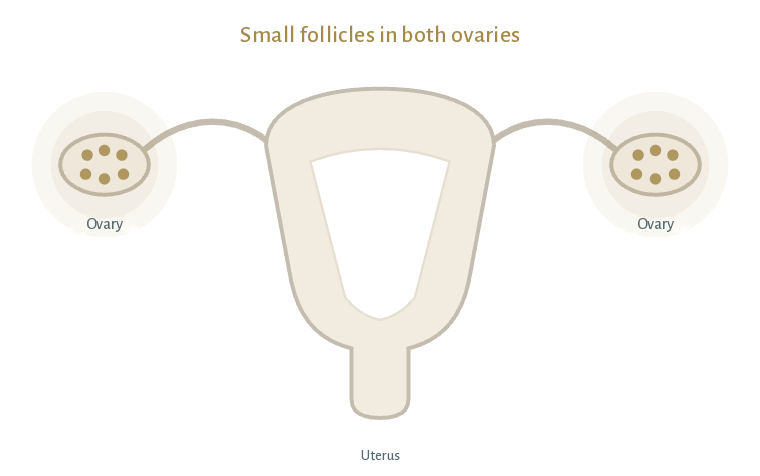
PCOS (polycystic ovary syndrome)
PCOS (renamed PMOS in 2026) is a hormonal and metabolic condition that can come with irregular periods, excess hair growth and acne. In some people, many small follicles are seen on ultrasound; these follicles are not the same as ovarian cysts, and they do not have to be present for PCOS to be diagnosed.
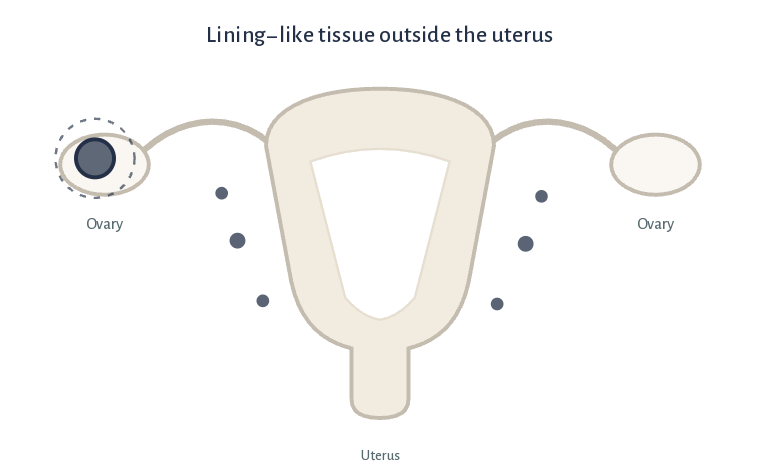
Endometriosis
Tissue similar to the lining of the uterus grows outside the uterus. When it affects the ovary, it can form a “chocolate cyst” (endometrioma), which is a type of ovarian cyst. Endometriosis may come with period pain or pelvic pain, but some people have no symptoms.
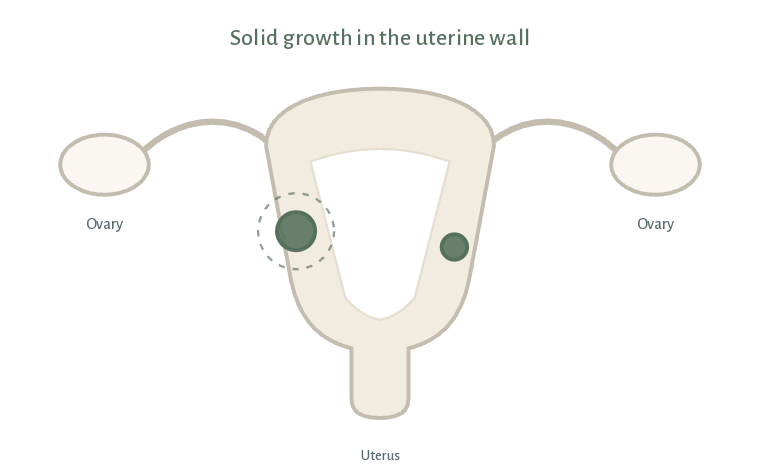
Uterine fibroids
A benign (non-cancerous) growth that starts in the muscle of the uterus. It can grow within the wall, into the cavity or on the outer surface of the uterus. Fibroids are usually solid and do not come from ovarian tissue.
An accurate diagnosis cannot be made from a single symptom. Your doctor uses your medical history, a physical exam and, when needed, an ultrasound or blood tests to find the underlying cause and tell these conditions apart.
Is it an ovarian cyst or pregnancy?
An ovarian cyst and a pregnancy can happen at the same time. In early pregnancy, some cysts are corpus luteum cysts, and they often go away on their own as the pregnancy progresses. Small, simple cysts usually cause no problems; whether follow-up is needed depends on the cyst’s size and appearance and on your symptoms.
If your period is late and you could be pregnant, take a pregnancy test. If you tested early and the result was negative, you may need to repeat it a few days later. If needed, your doctor will order a blood test or an ultrasound to check for pregnancy, a cyst and other causes.
Common myths about diagnosing ovarian cysts
“If you have a cyst, you definitely won’t get your period.”
A cyst does not always stop your periods. Some cysts can make a period late or irregular, but a late period on its own is not a sign that you have a cyst.
“Heavy bleeding means the cyst is coming out.”
An ovarian cyst does not come out with menstrual bleeding. Many functional cysts gradually shrink and the body absorbs their fluid; heavy bleeding is not a sign that a cyst is going away.
“A cyst comes out through the vagina.”
A cyst sits on or inside the ovary and does not come out through the vagina.
“An ultrasound can rule cancer in or out with 100% certainty.”
Ultrasound helps estimate the chance of cancer, but on its own it cannot confirm or rule out cancer for certain.
“A blood test can show a cyst.”
Ultrasound is the main way to see a cyst; a blood test cannot confirm a cyst on its own.
What happens after an ovarian cyst is diagnosed?
A cyst diagnosis does not always mean immediate treatment or surgery.
Many simple, low-risk cysts go away without treatment. When needed, a follow-up ultrasound is done; some small, simple cysts do not even need a repeat ultrasound.
The next steps depend on the cyst’s type, appearance and size, your symptoms, your age and your menopausal status.
To learn about monitoring, medicines and when surgery is considered, read the ovarian cyst treatment page.
When does an ovarian cyst need urgent medical care?
Most cysts do not cause an emergency, but some symptoms need urgent assessment.
Symptoms you should not ignore
Sudden, severe pelvic pain, especially with nausea or vomiting, dizziness or sudden weakness, can be linked to a ruptured cyst or ovarian torsion (a twisted ovary) and needs urgent medical care.
Questions to ask your doctor about an ovarian cyst
- What type of cyst do I have, and does it look simple or complex?
- Is there any finding that needs further tests?
- Do I need a blood test or other imaging?
- If I need a follow-up ultrasound, when should I have it?
- Could this cyst or its treatment affect my fertility?
Frequently asked questions about diagnosing ovarian cysts
Do I need surgery if my ultrasound report says “23 mm follicle” or “hemorrhagic cyst”?
Not necessarily. A follicle can be a normal part of the cycle, and many hemorrhagic cysts also go away with follow-up. The decision about surgery is not made based on the number alone.
Is a 3 cm, 5 cm or 7 cm cyst dangerous?
The follow-up plan for simple ovarian cysts depends on their size and your menopausal status. Simple cysts smaller than 3 to 5 cm usually need no specific action, and larger cysts are monitored with ultrasound at regular intervals.
My home pregnancy test is negative and my period is late. Could I have a cyst?
Possibly, but a negative home pregnancy test does not prove you have a cyst, and a late period has many causes. If your period continues to be late, talk to your doctor about which test is right for you.

Your questions
No question has been published on this page yet.
Ask the first one. The answer is published right here, under your question.






Write your question