


Uterine Cancer Diagnosis
Symptoms, tests and the steps of assessment
- Most abnormal bleeding is not caused by cancer, but any bleeding or spotting after menopause should be checked, even if it is light or happens only once.
- A thick endometrium (uterine lining) on ultrasound does not, on its own, confirm cancer.
- A confirmed diagnosis comes from examining a tissue sample. Having a biopsy does not mean having your uterus (womb) removed.
- An endometrial biopsy in a doctor's office or clinic usually takes about 5 to 15 minutes.
- Atypical hyperplasia, or EIN (endometrial intraepithelial neoplasia), is a precancerous change in the lining of the uterus that needs to be assessed and treated.
- In about 30 to 50 percent of women who have a hysterectomy after a diagnosis of EIN or atypical hyperplasia, examination of the removed uterus also shows cancer.
From anywhere in the world
Tehran clinic services
Waiting for test results: coping with stress and what to do in the meantime
Abnormal bleeding or an abnormal finding on ultrasound does not, on its own, mean cancer. If a symptom or a test result has worried you, it is still too early to draw any conclusion about a diagnosis.
Below, we explain what each test shows and how its result helps decide the next step.
- Pathology results may take a few days to a few weeks; additional tests can make this longer.
- Nothing is certain until the result is ready. Many samples show benign (not cancer) or manageable changes.
- Write down your symptoms and prepare a list of questions for your next appointment → (questions to ask at your appointment).
- Constant searching online can increase anxiety. Avoid comparing your result with other people’s.
- If you have heavy bleeding, unusual pain or a fever, do not wait for the result; contact your doctor sooner.
Screening tests vs. diagnostic tests for uterine cancer: what's the difference?
Screening checks people who have no symptoms. Diagnostic tests are done to find the cause of symptoms or to look into abnormal findings.
For endometrial cancer, routine screening is not recommended for people who have no symptoms and are at average risk.
If you have abnormal bleeding, your doctor may order an ultrasound or a biopsy.
Uterine cancer vs. cervical cancer: what's the difference?
Uterine (endometrial) cancer
It starts in the inner lining of the uterus and is usually not linked to HPV. Its main symptom is abnormal bleeding, and it is assessed with a transvaginal ultrasound and an endometrial biopsy.
Cervical cancer
It starts in the cervix, and most cases are linked to HPV. Screening is done with an HPV test, a Pap test (Pap smear; in the UK, a smear test), or both together. If more assessment is needed, a colposcopy is done.

About this image: The endometrium is the inner lining of the body of the uterus, and most uterine cancers start there. The cervix is in the lower part of the uterus, and cervical cancer is different from endometrial cancer. A Pap test checks cells from the cervix, so a normal Pap test result does not rule out endometrial cancer.
Diagnosing uterine cancer step by step: in what order are the tests done?
The type and order of tests depend on your symptoms, your situation and any earlier results. Some tests may be done at the same time, and not everyone needs every one of these steps.

Pelvic exam
Your doctor checks the size, position and firmness of the uterus and feels for any lump. If needed, a rectovaginal exam (checking the pelvis through the vagina and rectum) is also done.
Transvaginal ultrasound
This scan looks at the thickness and appearance of the endometrium (the lining of the uterus). A transvaginal ultrasound usually gives a more detailed picture of the endometrium than an abdominal ultrasound, but its result alone is not enough to confirm a diagnosis of cancer.
Endometrial biopsy
A diagnosis of endometrial cancer is confirmed by examining a tissue sample in a pathology lab. In a biopsy, only a small amount of the uterine lining is taken; this does not mean removing the uterus, and it is different from surgery to remove the uterus (hysterectomy).
Hysteroscopy and diagnostic D&C (dilation and curettage)
If the sample is not enough, the result does not explain the bleeding, or the bleeding continues, your doctor may suggest a hysteroscopy. In this procedure, the inside of the uterus is examined with a thin camera, and a sample is taken from any abnormal-looking area if needed. Sometimes a D&C (dilation and curettage) is also done to collect tissue.
Tissue and molecular tests
Examining the tissue shows the type of cancer and its grade. Molecular tests such as POLE, MMR (mismatch repair) and p53 also help describe the tumor’s features and can place it in one of four groups: POLEmut (POLE-mutated), MMRd (mismatch repair-deficient), p53abn (p53-abnormal) or NSMP (no specific molecular profile).
Together with the stage of the cancer, this information helps guide the choice of treatment. The MMR result can also show whether further assessment for Lynch syndrome, an inherited condition, is needed.
Imaging to check spread and find the stage
Depending on your results, your doctor may order an MRI, a CT scan or, in certain cases, a PET-CT scan. These scans help show whether the cancer involves the wall of the uterus, the lymph nodes or other organs. Not everyone needs all of these scans.
Does a thick endometrium mean I have cancer?
No. A thick lining on its own does not mean cancer. This measurement is one piece of information that helps your doctor decide about further tests or a biopsy. It is read differently before and after menopause.
Endometrial thickness in women with vaginal bleeding after menopause
Endometrial cancer is less likely, but this number alone is not enough to rule out cancer or to decide about a biopsy.
Even with a thin endometrium, further assessment is needed. An earlier ultrasound result does not replace follow-up of the bleeding.
With bleeding after menopause, a biopsy is usually needed, but this number on its own does not mean cancer.
Bleeding after menopause should be checked, even if the endometrium is thin. For most people, the first assessment includes a transvaginal ultrasound and an endometrial biopsy. Your doctor decides which tests are needed based on your symptoms, risk factors and the ultrasound findings.
Endometrial thickness before menopause
During the reproductive years, the thickness of the endometrium changes with the day of the menstrual cycle, so a single fixed number means little on its own. Your doctor looks at it together with your age, how long the bleeding has gone on and your risk factors.
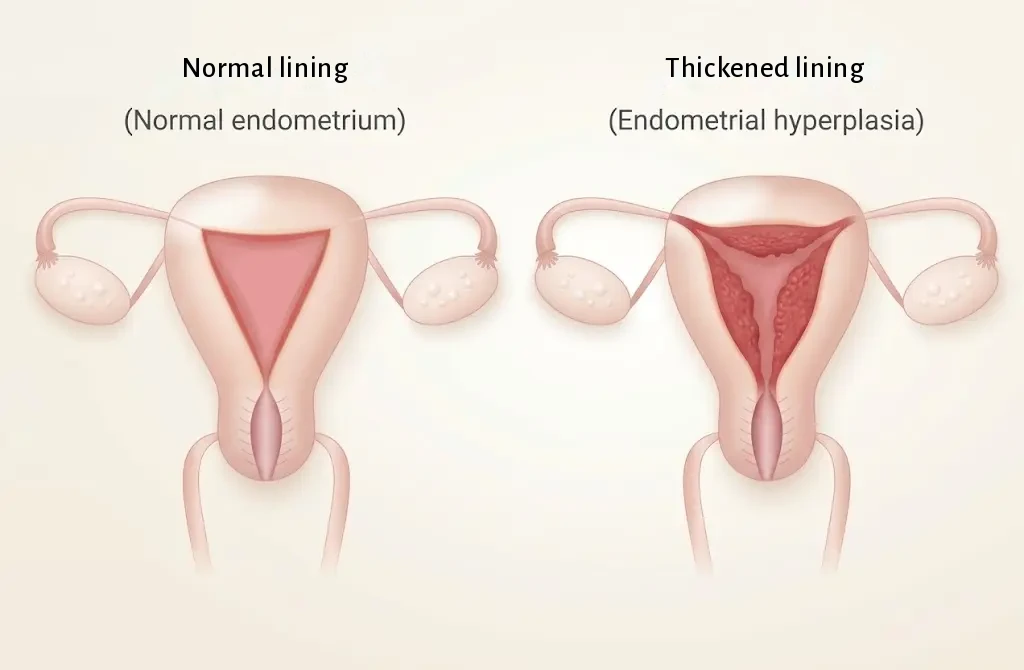
About this image: A normal endometrium (left) compared with an overgrown, thickened uterine lining (right). The image on the right shows more glands and a thicker endometrium.
What does it mean if a result says “precancer,” “unclear” or “inflammation”?
These results do not mean the same thing. Precancer is different from cancer, but it needs follow-up and sometimes treatment. “Unclear” means more assessment is needed before a conclusion can be reached. Inflammation on its own does not mean cancer either. The next step depends on the exact wording of the report and your situation.
Inflammation or infection
Inflammation means the tissue shows an inflammatory reaction. This finding on its own does not mean infection or cancer.
Your doctor looks into the cause of the inflammation and whether it needs treatment. If an infection is found, it is treated. Bleeding that continues or comes back also needs to be checked again.
Hyperplasia without atypia
The lining of the uterus has grown too much, but the cells do not show the abnormal changes called “atypia.” The risk of this condition turning into endometrial cancer is less than 5 percent over 20 years.
Treatment with progesterone, with biopsies to monitor the lining, is usually considered. Surgery is usually not the first choice; the choice of treatment depends on symptoms and on follow-up results.
Atypical hyperplasia or EIN
A precancerous change in the lining of the uterus. In about 30 to 50 percent of people who have a hysterectomy after this diagnosis, endometrial cancer is also found when the removed tissue is examined. This figure is not the chance of developing cancer in the future.
The usual definitive treatment is removal of the uterus (hysterectomy). For selected people, including those who want to keep their fertility, treatment with progesterone may be considered once the chance of a cancer already being present has been checked. This approach needs close follow-up and a repeat biopsy within 3 to 6 months.
Unclear or needs more assessment
The result on its own is not conclusive.
A repeat biopsy, or a targeted biopsy during hysteroscopy, may be needed.
When should I see a doctor, and which kind of doctor?
Symptoms that should be checked promptly
- Any amount of bleeding or spotting after menopause
- Spotting between periods, bleeding during or after sex, or unusually heavy periods
- Unusual vaginal discharge or ongoing pelvic pain
Which specialist should I see for diagnosis and treatment?
A gynecologist does the first assessment and, if needed, refers you on. Once cancer is confirmed, the treatment plan is usually set under the care of a gynecologic oncologist.
Questions to ask at your appointment
- What exactly does my test result mean, and which category does it fall into?
- Do I need a biopsy or more tests? Which ones, and why?
- What is the next step, and when should it happen?
- If the diagnosis is confirmed, what happens next?
- Should my family history or genetic status be checked?
If you are a family member or caregiver
You can help write down symptoms and questions and, if the person would like, go with them to appointments. Tell the doctor about any history of uterine, colon or ovarian cancer in the family, even if only one relative was affected. The family relationship and their approximate age at diagnosis can also help the assessment.
Frequently asked questions about diagnosing uterine cancer
Can a blood test show uterine cancer?
No. There is no specific blood test for the initial diagnosis of uterine cancer. CA-125 is used only in some situations, for staging or follow-up after diagnosis.
Can uterine cancer be found before symptoms appear?
Yes. Endometrial cancer is sometimes found during tests done for other reasons, before symptoms appear. Even so, about 90 percent of people with it have abnormal bleeding. Routine screening is not recommended for people without symptoms who are at average risk; for people at high risk, the plan for testing and follow-up is different.
If I have a family history, will I definitely get it?
No. A family history can raise the risk, but it does not mean you will definitely get it. Tell your doctor about any history of uterine, colon or ovarian cancer in your family, along with the family relationship and the age at diagnosis. Based on this information and your test results, your doctor will decide whether genetic counseling and assessment for Lynch syndrome are needed.
Is cervical ectropion the same as cancer?
No. Cervical ectropion is a benign (not cancer) change on the cervix and is not the same as uterine cancer.

Your questions
No question has been published on this page yet.
Ask the first one. The answer is published right here, under your question.






Write your question