


Ovarian Cancer: A Complete Guide
From symptoms and diagnosis to prevention and treatment
- Bloating, feeling full quickly, and abdominal or pelvic pain need to be checked if they are new and persistent.
- A Pap test (Pap smear; in the UK, a smear test) does not show the condition of the ovaries, and there is no effective population-wide screening for ovarian cancer in people at average risk who have no symptoms.
Find your starting point:
- If you have persistent symptoms or a mass with concerning features, start with Ovarian cancer diagnosis;
- if cancer has been confirmed, read Ovarian cancer treatment;
- and if you have questions about family history or lowering your risk, go to Ovarian cancer prevention.
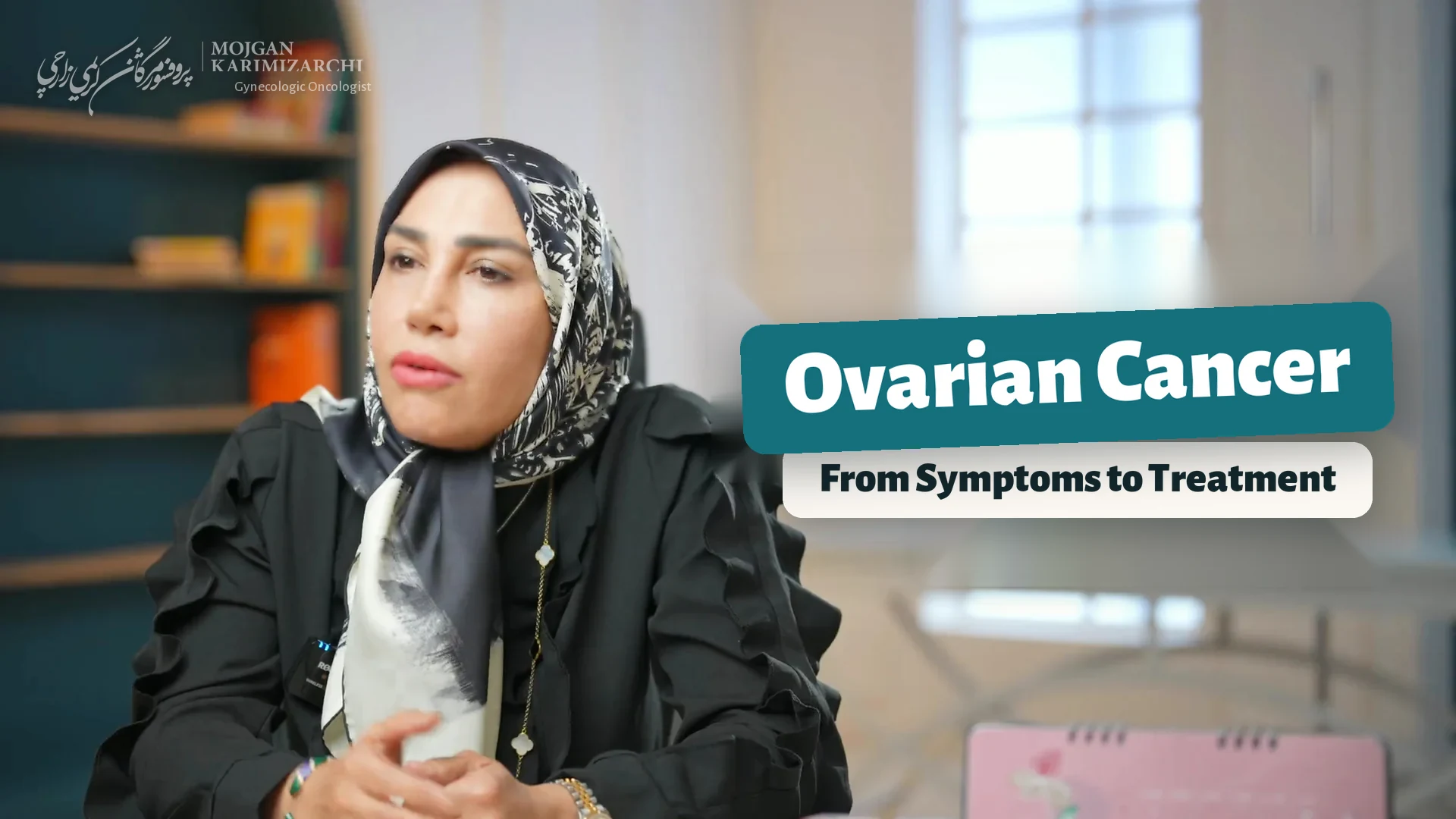
What is ovarian cancer, and what are the symptoms?
What is ovarian cancer?
Ovarian cancer is an abnormal growth of cells in the ovary or the tissue around it. The most common type, high-grade serous cancer, often starts at the far end of the fallopian tube.
Who is at higher risk?
The risk of ovarian cancer rises with age, and most cases are diagnosed after menopause. A family history of ovarian or breast cancer, changes (mutations) in the BRCA1 and BRCA2 genes, and Lynch syndrome also raise the risk.
Why can ovarian cancer be diagnosed late?
In the early stages, there may be no clear symptoms.
Symptoms such as bloating, feeling full quickly, pelvic pain or pressure, and needing to urinate more often can also look like common digestive or urinary problems, which makes the disease harder to diagnose.
The difference between ovarian, uterine and cervical cancer
These are three different areas (the ovaries, the body of the uterus and the cervix, which is the lower part of the uterus). Each one has its own type of cancer, its own ways of prevention and its own tests.
A Pap test checks only the cells of the cervix, to screen for cancer in that area. It gives no information about the ovaries and cannot rule out or confirm ovarian cancer.
For women with no symptoms who are at average risk, ultrasound and the CA-125 test are not recommended as routine screening. These methods have not been shown to reduce deaths, and they may lead to unnecessary tests or surgery.
If symptoms such as bloating, feeling full quickly, abdominal or pelvic pain, needing to urinate more often or changes in bowel habits are new and have lasted two weeks or more, see a doctor to have them checked. Symptoms that keep coming back or get worse also need to be checked. These symptoms do not necessarily mean cancer, but they should not be ignored.
Finding the right next step for your situation
An ovarian mass on ultrasound
Most ovarian masses (growths on the ovary) are not cancer, and nothing definite can be said about what a mass is until the final results are ready.
What matters is following up on a mass that has concerning features, gets bigger at a later check, or changes in appearance.
Needs further assessment: a solid mass or one with prominent solid parts, a large or growing mass, abnormal blood flow on a Doppler ultrasound, or fluid in the abdomen (ascites) along with the mass
High CA-125 on a blood test
CA-125 is not specific to cancer. Endometriosis, pelvic infection (pelvic inflammatory disease), fibroids and menstrual periods can also raise it, especially before menopause.
A high number on its own does not confirm cancer, and a normal number does not rule it out. The result should be interpreted together with symptoms and ultrasound findings.
Referral to a gynecologic oncologist for a mass with concerning features
A referral to a gynecologic oncologist does not mean cancer has been confirmed. It is part of a careful assessment of the mass.
If a mass has concerning features, assessment by a gynecologic oncologist, and surgery by one if needed, can improve the accuracy of the assessment and the quality of staging.
The diagnosis page explains each of the points above in more detail.
Confirmed ovarian cancer: choosing treatment
Treatment for ovarian cancer depends on the type of tumor, the stage of the disease and the patient’s overall condition.
Surgery and chemotherapy are the main treatments.
Why does the surgeon’s experience matter? The quality of the first surgery, especially how much tumor tissue is left behind, can affect the outcome of treatment. That is why it matters that surgery is done under the care of a gynecologic oncologist.
Second opinion: You have the right to raise your concerns and, if needed, to get a second opinion.
From anywhere in the world
Follow-up after treatment and changes in CA-125
Follow-up continues after treatment, and its schedule is based on the state of the disease and how it responded to treatment.
A small fluctuation in CA-125 does not always mean the cancer has come back. What matters is how the number changes over time, together with symptoms and other tests.
The treatment page explains both of the points above in more detail.
Family history of ovarian or breast cancer and BRCA mutations
If you have a family history of ovarian or breast cancer, or tests have found a harmful inherited variant (mutation) in your BRCA1 or BRCA2 gene, genetic counseling can help assess your risk and choose ways to lower it.
Having a family history or one of these mutations does not mean you will definitely get cancer.
Preventive surgery is not for everyone. Whether it is needed, and when, depends on your inherited risk, your plans for having children and the effects of menopause.
Frequently asked questions about ovarian cancer
Numbers such as “she has only five years to live” mean nothing for one person. Survival statistics are averages for large groups and cannot predict how one patient’s treatment will go.
In the early stages and with some tumor types, it is sometimes possible to keep the uterus (womb) and one ovary with conservative (fertility-sparing) surgery. Whether this is possible depends on the tissue type and the stage of the disease. Before a decision on surgery is made, talk about fertility with a gynecologic oncologist.
No. Ascites on its own does not determine the stage or the outlook (prognosis), and it needs to be assessed by a specialist.
There is no evidence that cutting out sugar or herbal treatment gets rid of cancer. These approaches are not a substitute for medical treatment.
During treatment, a balanced diet and eating enough matter more than strictly cutting out a whole food group.

Your questions
No question has been published on this page yet.
Ask the first one. The answer is published right here, under your question.






Write your question